
Spiritual Director.
Inventor.
Entrepreneur.
Author.
Spiritual Director. Inventor. Entrepreneur. Author.
#themanifesto
People can build lives that are impressive, accomplished, even meaningful—and still sense there is more life available to them.
More truth. More depth. More freedom. More capacity to love. More aliveness.
This feeling isn’t necessarily about trying to “fix” your life.
It’s about inhabiting your life more fully.
That’s where my work lives.
The Upper Edge
Abraham Maslow is best known for describing a progression of human needs: survival, safety, belonging, esteem and, eventually, self-actualization.
Later in his work, he became increasingly interested in something beyond even self-actualization:
self-transcendence.
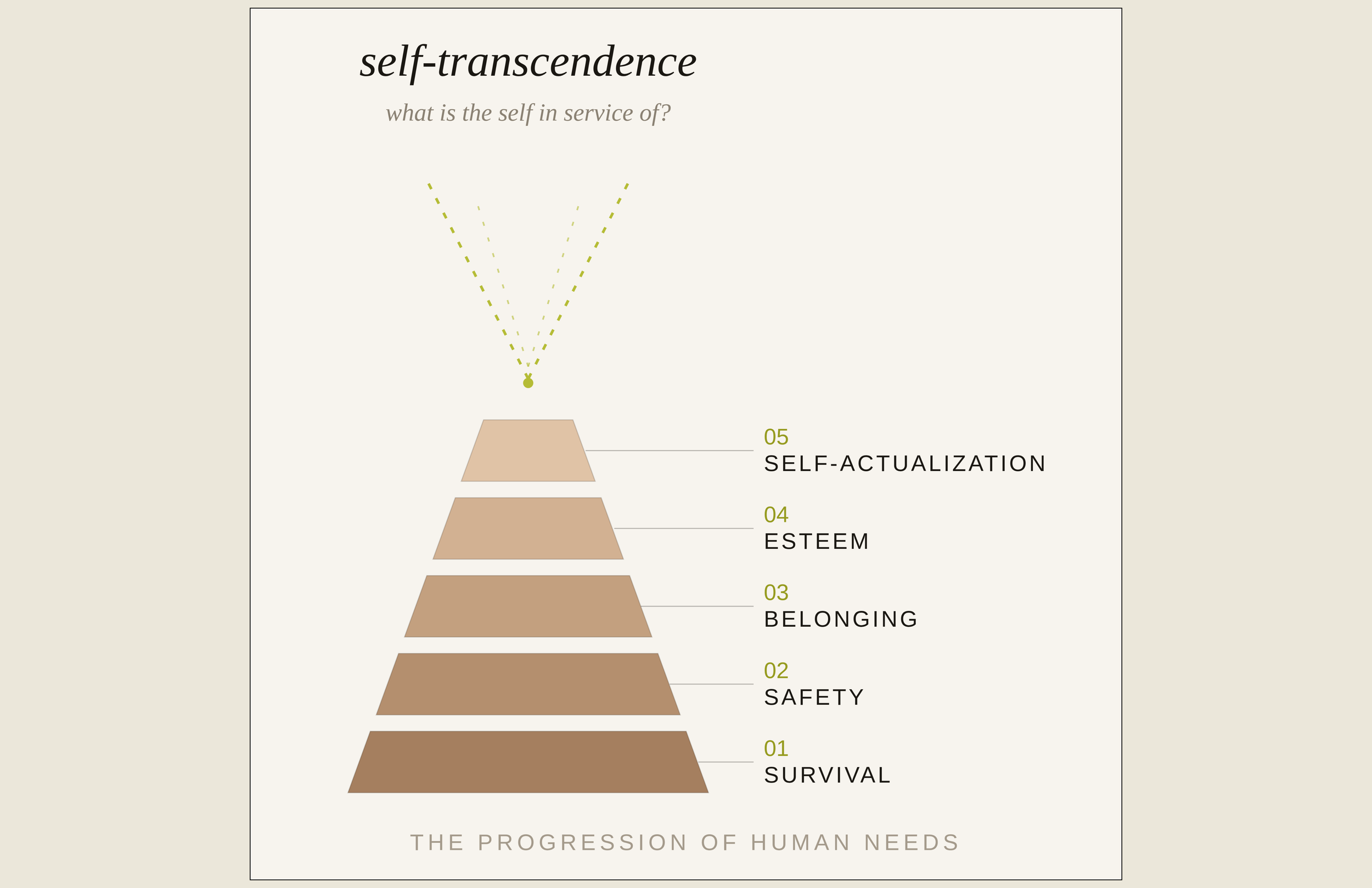
The movement from building the self to asking what the self is in service of.
This is the territory I explore.
Humans have developed many languages for it.
Of the hundreds of theories, traditions and frameworks I’ve encountered over the last decade, I return to a handful again and again—not because any one of them contains the answer, but because each one rearranges the way you see your life.
Five ways of seeing a life:
-
Most of us are taught to think about purpose as a career question:
What am I meant to do?
A better question is:
What is my life pointed toward?
Because you can accomplish almost everything you intended to accomplish and eventually discover that accomplishment itself cannot tell you what any of it is for.
Purpose introduces direction.
It asks whether the choices you make, the people you give yourself to, the work you undertake and the person you are becoming have some underlying alignment.
Not a perfect five-year plan.
A north star.
There is a profound difference between a life filled with activity and a life organized around something you believe is worthy of your limited time here.
That is the question purpose asks.
-
This one is much more provocative.
The Jewish idea of tikkun carries the language of repair.
And it offers a very different way of thinking about a meaningful life.
Instead of asking only:
What do I want from my life?
It invites another question:
What has life placed close enough to me that I might have some responsibility for its repair?
Maybe that is something in your family.
Something in your community.
A wound that has traveled through generations.
An injustice you cannot stop noticing.
A way of treating people differently because you know what it feels like to be treated otherwise.
This idea moves us away from the modern obsession with designing the perfect life.
Maybe not everything in your story exists for your personal fulfillment.
Maybe some of what you have lived has made you particularly capable of tending to something that needs tending.
That possibility changes the way you interpret your own biography.
-
This Japanese philosophy asks us to look at four questions:
What do I love?
What brings passion, energy, curiosity, devotion, or joy?
What am I good at?
Where have I developed real ability, instinct, or mastery?
What does the world need?
Where might what I carry meet something beyond myself?
What can I be paid for?
What can be translated into real economic value?
Your ikigai, or reason for being, lives in the intersection of these four questions.
It is not asking for perfect balance or a magical career that checks every box.
It is asking for greater coherence between what you love, what you can offer, what the world asks of you, and how you sustain yourself.
-
Ubuntu, one of South Africa’s most famous philosophies, challenges one of the deepest assumptions embedded in Western self-actualization: that the self is primarily an individual project.
Its provocation is closer to: What if becoming fully yourself is impossible in isolation?
Who you become is shaped by who has loved you.
Who has carried you.
Who you are responsible for.
Who gets to flourish because you flourished.
Ubuntu asks us to consider not only, Who am I becoming?
But: Who am I becoming in relationship to everyone and everything around me?
-
And then there is positive psychology.
PERMA is less metaphysical than the others, which is precisely why I like having it here.
It brings us back to earth.
Positive emotion.
Engagement.
Relationships.
Meaning.
Accomplishment.
It asks us to stop speaking abstractly about whether life is “good” and look at its actual construction.
You might be extraordinarily accomplished and profoundly lonely.
Deeply loved but chronically disengaged.
Full of pleasure but lacking meaning.
Devoted to meaningful work while experiencing almost no joy.
A life can look successful in aggregate while being quietly impoverished in one of its essential dimensions.
PERMA gives us a way of noticing.
Different traditions. Different languages.

All circling an ancient human question:
What does it mean to live a life that is deeply, unmistakably mine—and worthy of the life I have been given?

When you reach this question, the invitation is to inhabit your own house of knowledge.
The lessons life has taught you—not just intellectually, but in the deepest parts of you.
The things you know because you have loved.
Because you have lost and because you have won.
Taken together, they form the particular wisdom of your life. The wisdom you have earned.
The invitation is to pay attention and to listen.
listen to what your body knows.
listen to what no longer fits.
listen to the questions that keep returning.
listen to the people you love.
listen to the sacred.
This is the upper edge of human possibility.
The lifelong practice of living fully alive.